Individual technique in freefall
One of the main motivations in our sport practice is the opportunity to participate in group jumps. However, as in all areas of skydiving, being part of such jumps carries signicant responsibility, as our actions affect not only ourselves but also the other individuals involved in the jump.Participating in group jumps requires basic theoretical knowledge of skydiving, as well as fundamental skills in freefall and under canopy. For this reason, the USPA (United States Parachute Association) has developed a comprehensive pre-jump preparation method that every skydiver must follow before beginning to participate in group jumps, which culminates in the achievement of the A license.
Obtaining the USPA A license grants the following privileges to any skydiver: jumping without supervision, packing their own parachute, participating in basic group jumps, and being able to participate in the wet training for water landings.
The theoretical knowledge required to obtain the A license is extensive enough to be covered in a single blog section. However, you can refer to the corresponding chapters in the study guide for licenses in appendix 3 of the USPA Skydivers’ Information Manual (SIM).
On this occasion, we will focus only on explaining the individual freefall technique that every skydiver must master to ensure safe participation in group jumps.
Exits
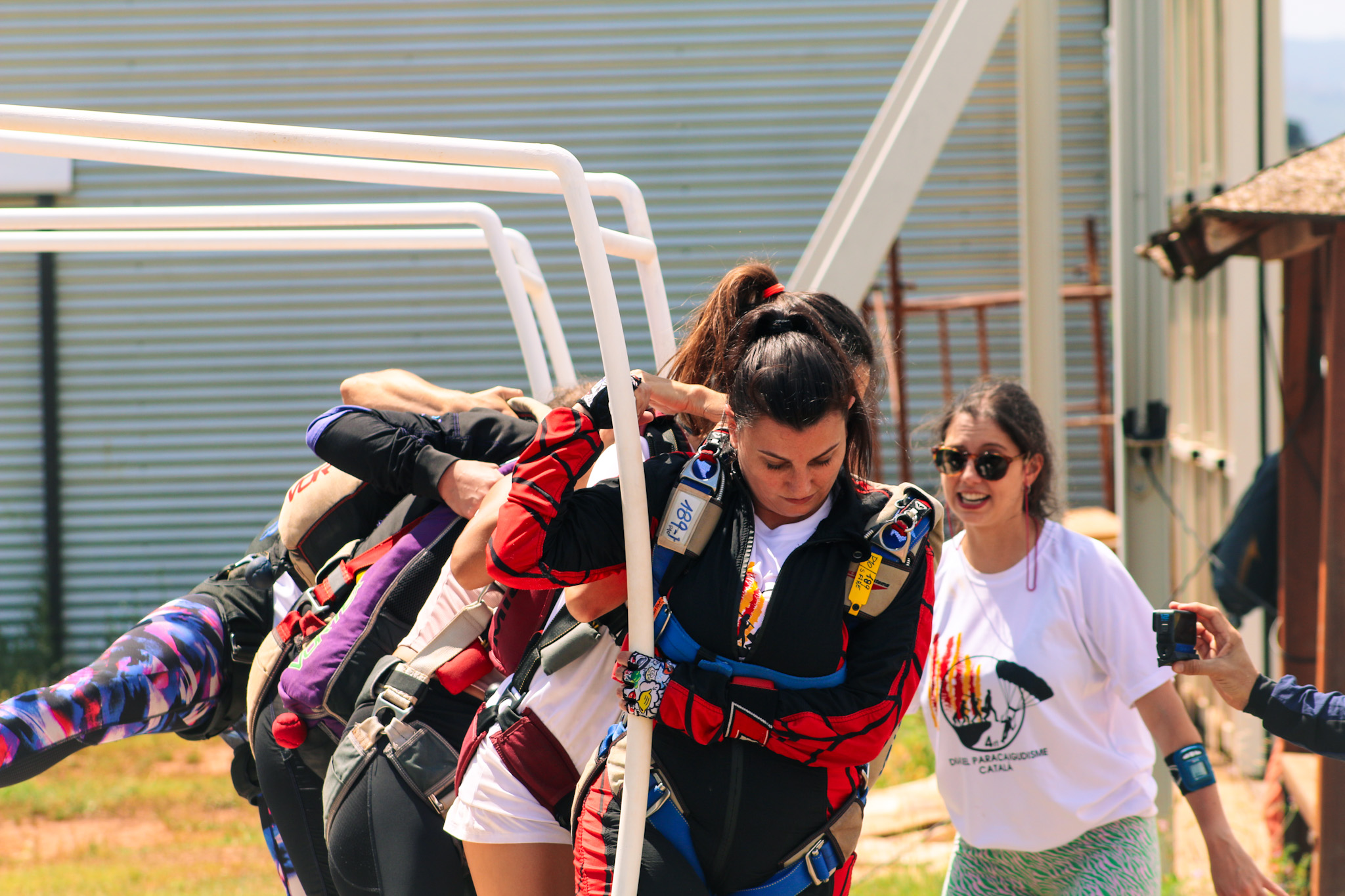
Each skydiver in a group has an assigned exit position and must be familiar with it and have practiced it repetitively before boarding. This position must include the exact and specic location of the feet and hands to achieve the best exit position and proper presentation of the hips and limbs to the relative wind.
To promote a simultaneous or nearly simultaneous exit that is efcient and safe for all jump members, a group count must be made, marked by a bodily movement that is clear and visible to all participants. It is essential to ensure that exits are stable regardless of our position at the door, always presenting ourselves correctly to the relative wind.
Skydivers exiting in a oater position, before the base, must be prepared to reduce their descent rate, helping the base reach their level as quickly as possible. Those exiting in a dive position, after the base, must increase their descent rate to catch up with the base level. Those exiting from the base must ensure a very stable exit and a solid formation so that the other skydivers can safely reach the level.
Eye contact
The collision of two bodies in freefall can cause severe injuries or even fatalities. The greatest risk occurs when skydivers lose sight of one another and deploy their parachutes independently, creating a situation in which a skydiver in freefall collides with another who has already opened their canopy.
Therefore, it is extremely important that all jump members maintain eye contact with the formation (and have all participants in their visual eld) from exit until after the canopy pressurization, ensuring both a safe freefall and collision-free trafc under canopy.
Altitude awareness
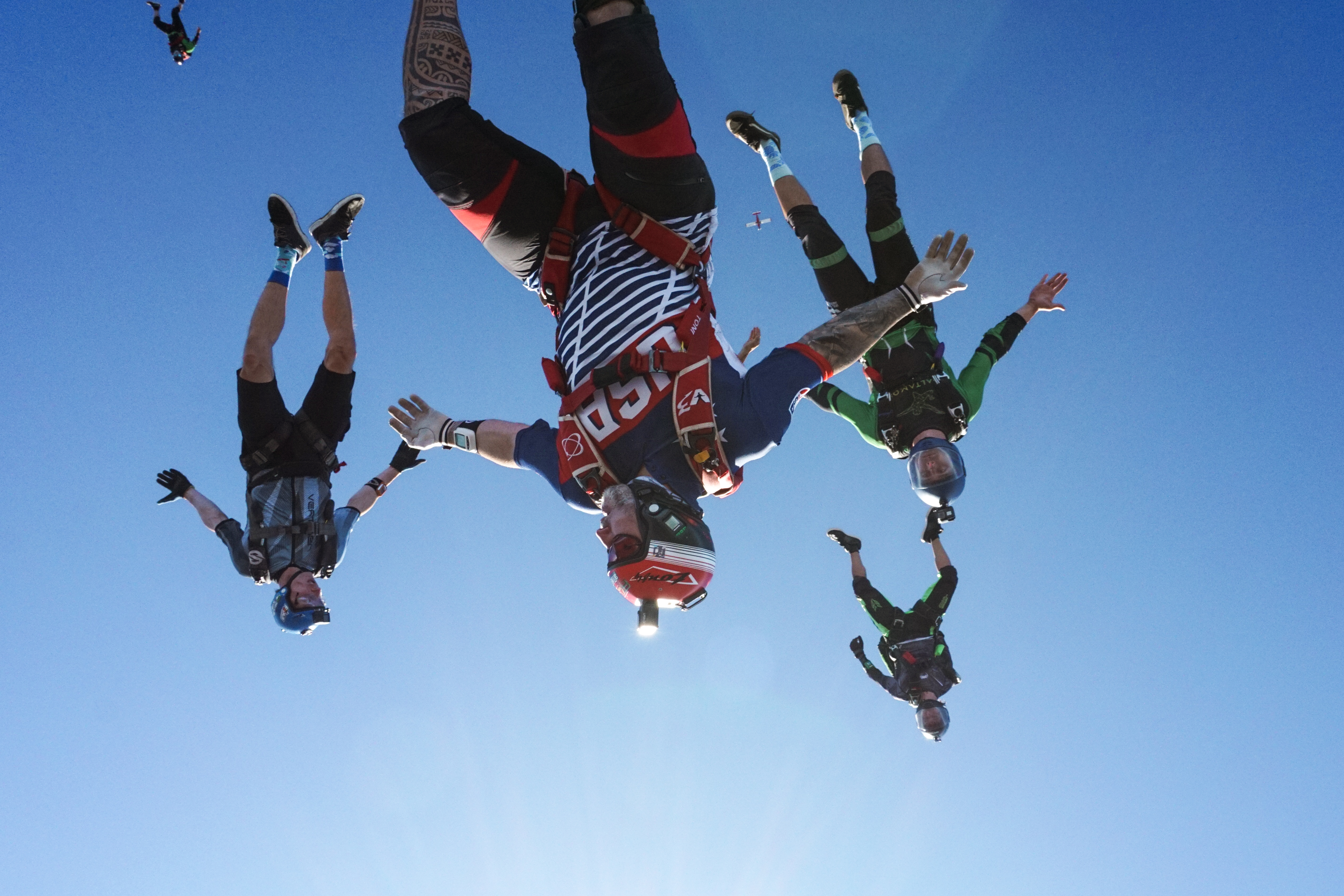
The excitement of participating in a group formation, combined with the pressure to perform our role within the jump, can capture all our attention and lead us to forget to constantly check our visual altimeter.
Remember that the altimeter should be checked every 5 seconds, every 1,000 feet, after every maneuver, and every time we lose control in freefall. Altitude awareness is crucial in group jumps, as, in addition to adhering to the planned deployment altitude, we must also respect the agreed altitude for the formation breakoff to distance ourselves as much as possible from other skydivers during the deployment.
It is highly recommended to also use an audible altimeter with alarms set for the breakoff and deployment altitudes. Never forget that the priority of the jump is to open the parachute, and secondly, to open it at the planned altitude.
Level control and approach
As mentioned earlier, collisions in freefall pose a signicant risk. Therefore, we must ensure we approach the formation properly, reaching the level rst before getting closer.
The LSD principle: Level, Slot & Dock is an excellent way to remember the correct way to approach a formation. The rst step is to reach level. If we are above the formation, we must increase our descent rate with a more pronounced arch. If we are below, we must rotate our body 90° relative to the formation and turn our head in such a way that we can always keep the formation in sight, immediately adopting the reverse arch position, increasing our surface area to “oat” until we reach the formation’s level.
Once level is reached, we must identify and occupy the corresponding slot for the position we want to enter in the formation.
Remember that we should always avoid being directly above or below the formation to avoid interfering with another skydiver’s bubble, or having them interfere with ours, which could cause collisions.
Finally, when we are in the correct position line, we must approach by extending our legs symmetrically until we can grab the formation, always keeping our arms short to avoid moving backward.
Once docked to the group, we must ensure we make eye contact with the partner directly in front of us (cross-partner) to maintain the level at all times, keeping our legs extended to provide stability to the formation.
Breakoff, separation track, and deployment
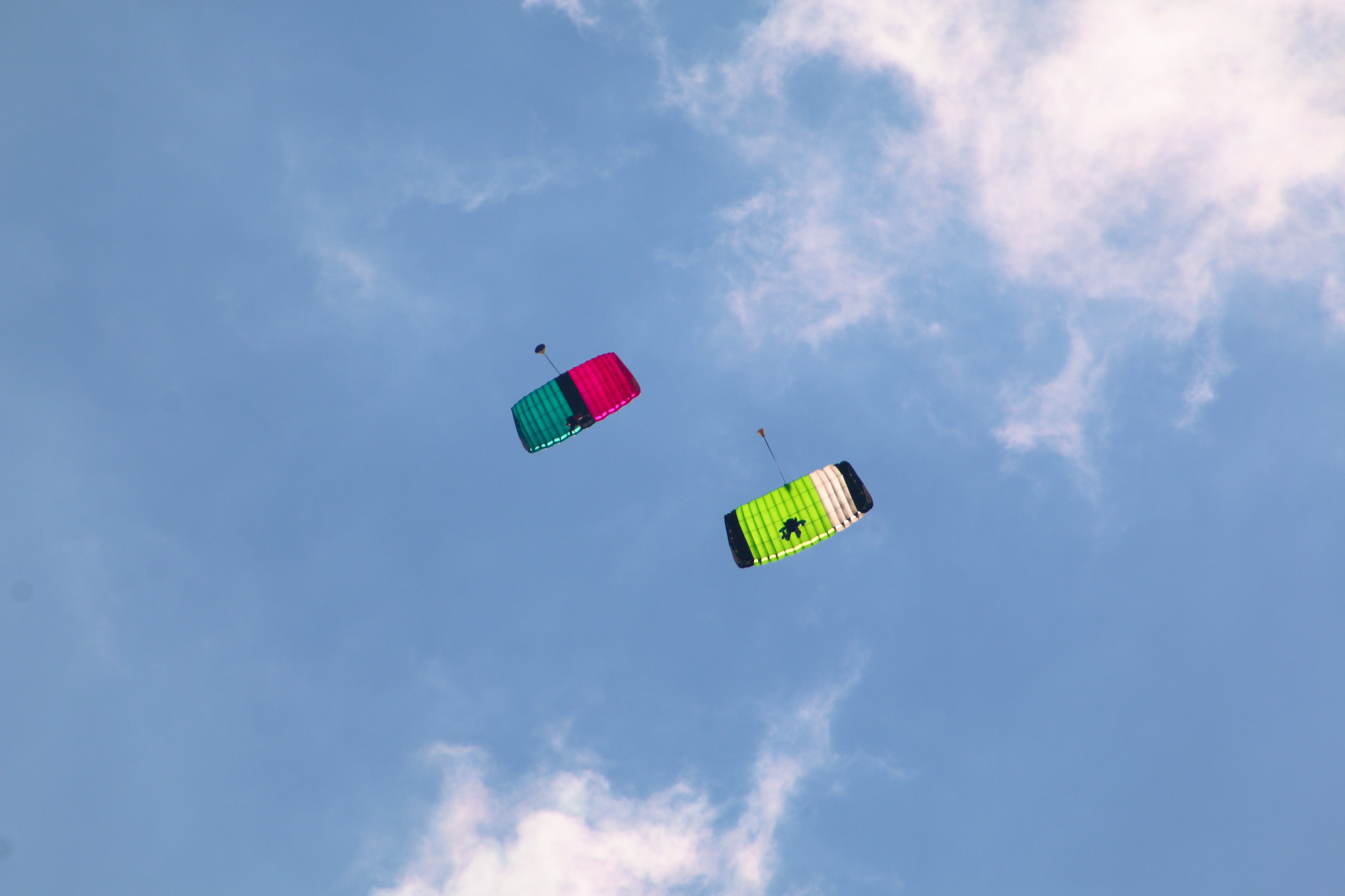
To promote safe separation and minimize the risk of collision during deployment, it is necessary to plan a good breakoff and adequate separation.
Once the breakoff signal is given, skydivers must break the formation, turn 180° from its center, and track at until reaching the planned deployment altitude. This is done to maximize the distance between all group members at the moment of deployment.
According to section 6-1 of the SIM, for groups of ve or fewer skydivers, breakoff should occur at least 1,500 feet above the highest planned opening altitude in the group. For groups of six or more, it should occur at least 2,000 feet above the highest planned opening altitude. At deployment, it is very important to execute the wave-off signal to alert the other skydivers, especially those who may be directly above us for
some reason. Additionally, during the wave-off, we must ensure we look in all directions to conrm that the area is clear.
Once the canopy is open, we must immediately check the trafc and remain alert to react quickly to the presence of other skydivers, remembering that the right of way belongs to the one who is below, both in freefall and under canopy. It is important to note that, at this moment, the jump is not over; it is only the beginning of the canopy ight phase, which involves a series of extensive checks and protocols until landing.
However, this is a broad topic that we will address in a future blog post. If you are still in the process of obtaining your A license and acquiring all the skills and knowledge to participate in formation jumps, it is advisable to read categories G and H of the SIM to understand the fundamental skills needed for a basic formation jump, as well as to resolve any doubts and plan the necessary jumps to complete the progression with your AFF instructors or coaches.
Bibliographic References
• USPA, Skydivers’ Information Manual, 2023 – 2024 edition. Section 6-1: (Group Freefall – Relative Work).
• USPA, Skydivers’ Information Manual, 2023 – 2024 edition. Section 4-G: (Integrated Student Program, Category G).
• USPA, Skydivers’ Information Manual, 2023 – 2024 edition. Section 4-H: (Integrated Student Program, Category H).