Aircraft: Routine protocols and emergency procedures
“A chain is only as strong as its weakest link.”
THOMAS REID
Our sport can be considered, metaphorically, as a chain of processes, where each link is of vital importance to the safety and normal development of the overall process.
On this occasion, we would like to address a topic that we believe doesn’t receive the attention it deserves, perhaps because it occurs infrequently. As the saying goes, “out of sight, out of mind”: aircraft emergencies.
“The Skydiver’s Information Manual, Section 5, contains only three sentences on aircraft emergencies! This not only reflects the fact that aircraft emergencies are rare situations, but also that there are so many variables to consider (type of aircraft and emergency, location of the DZ) that each drop zone must develop its own procedures and educate its jumpers.”
(USPA Safety Check, 2017)
Below, we quote directly the three sentences from Section 5-1 (emergencies in skydiving) of the USPA Skydiver’s Information Manual (SIM) that refer to aircraft emergencies:
Aircraft Emergencies:
- Every skydiving center must establish and review procedures for all possible aircraft emergencies.
- Every pilot and skydiver (non-student) must fully understand these procedures.
- All students must follow the instructions of their instructors.
Following USPA’s recommendations on this matter, we’ve decided to use this space to delve deeper into the subject. But before going into detail about aircraft emergencies, we would like to describe the routine procedures that allow us to have a standard or common protocol on how we should always behave around and inside aircraft to systematically minimize risks.
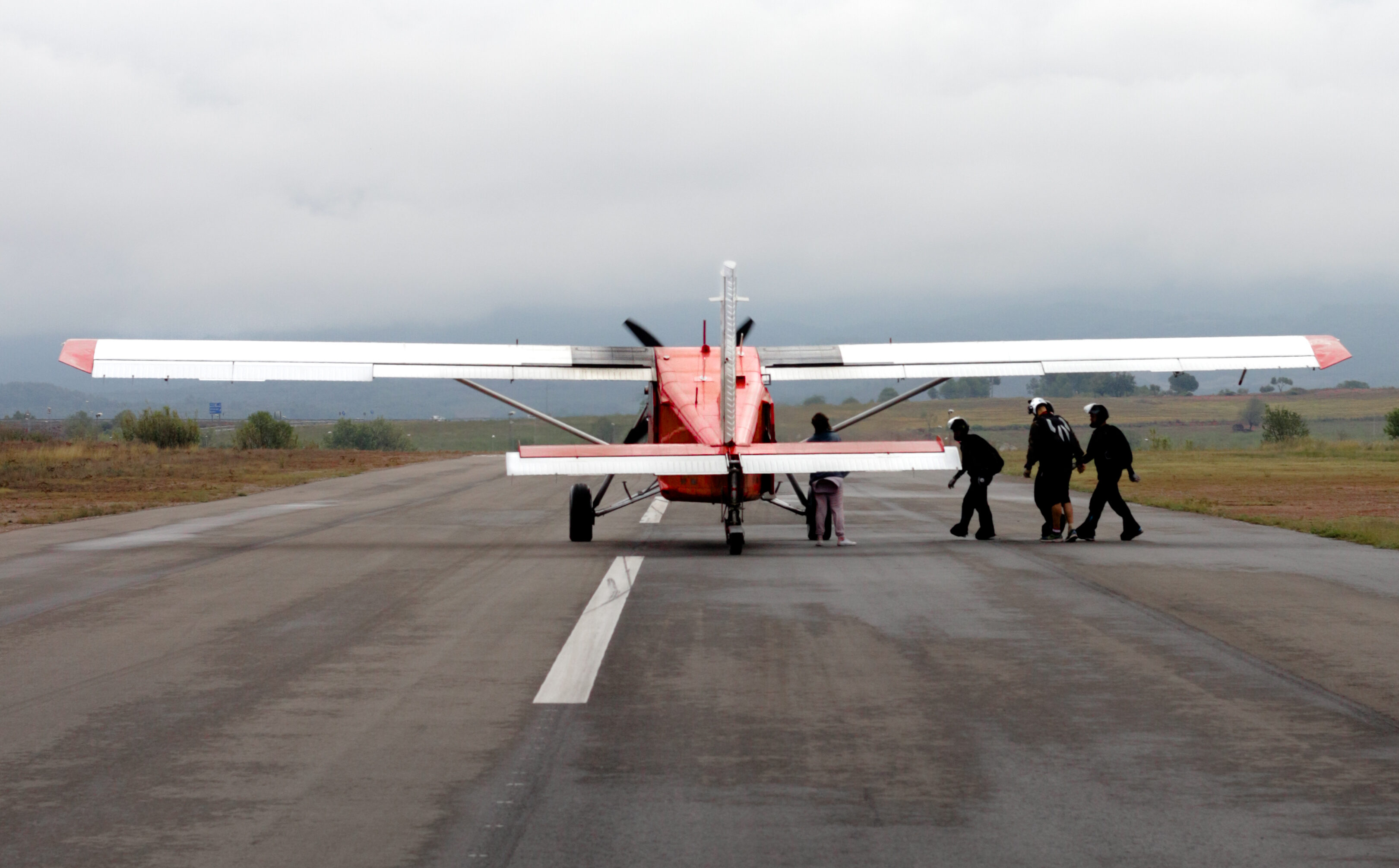
Approach to the Aircraft
The way we approach aircraft is very important and has a reason behind it: propellers are highly dangerous. For this reason, we must always approach avoiding getting close to the propellers or engines.
For aircraft with a front-mounted engine or propeller, we should always approach from the rear and on the side of the boarding door. In the case of helicopters, we should approach from the side opposite the tail rotor, walking from the front side, in order to avoid getting close to the tail of the helicopter and always staying clear of the rotor.
Additionally, we should always walk towards the aircraft with our handles protected at all times to prevent accidental activation from rubbing against other skydivers or friction with the door edges during boarding. That means: left elbow and forearm covering the reserve handle, left hand covering the cutaway handle, and right hand covering the pilot chute for the main parachute.
Although there are different types of aircraft, the general rule is always to approach away from propellers or engines, while covering our handles to avoid accidental openings during boarding.
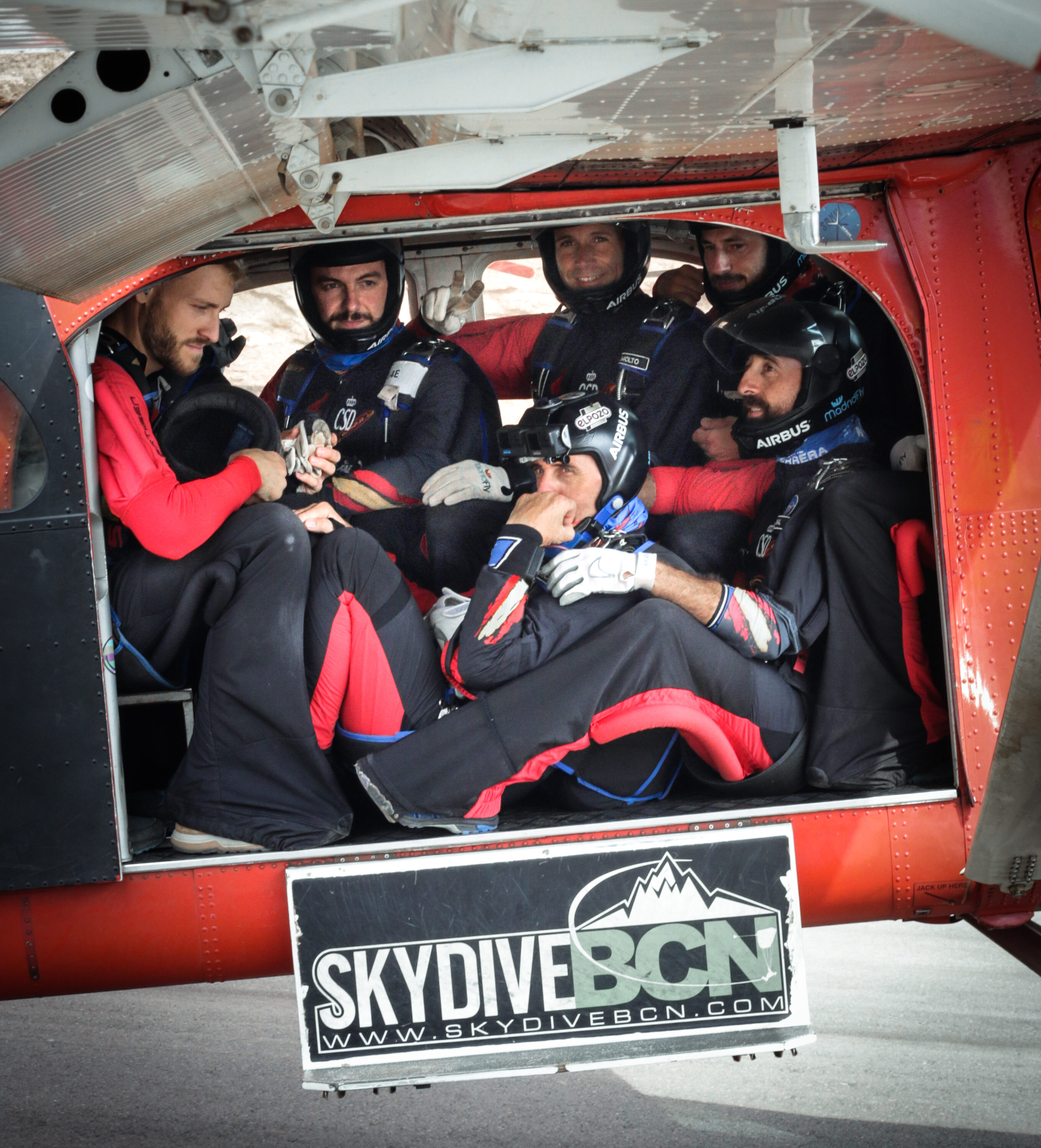
Behavior Inside the Aircraft
Once inside the aircraft, we should take the proper position, fasten our seatbelt (if available), ensure our helmet is secured, ensure the altimeter is on and at zero, and finally ensure our handles (main, cutaway, and reserve) are in the correct position.
Additionally, we must be aware of when to unfasten our seatbelt, based on our drop zone’s safety instructions, so we are not blocked by the seatbelt in case we need to move in a hypothetical emergency at a higher altitude.
The time during the ascent can sometimes be the most anxious, for various reasons. For this reason, it is advisable to use this time for breathing exercises, visualization, mental reviews of the jump, landing pattern, emergency procedures, or any other exercises that promote calmness and allow us to stay clear-headed to react to any unforeseen event.
Self-Check: The 3×3 Check
A great way to use the ascent time inside the aircraft is by reviewing our own equipment multiple times to reinforce our confidence and safety, using the 3×3 check, which we explained in detail in one of our previous blogs,
“How Many Times Should We Check Our Skydiving Equipment and When?”.
Remember that the 3×3 check is done as follows:
- Three handles: main, cutaway, and reserve. (Check that they are in the correct position).
- Three straps: chest and leg straps. (Check that they are properly fastened).
- Three rings and RSL: (Check that they are properly assembled).
- Accessories: altimeter on and calibrated, helmet fastened, goggles adjusted, radio working (if needed).
Let’s not forget that, although it’s necessary to perform at least four checks during the pre-jump phase: before gearing up, after gearing up, before boarding the aircraft, and before jumping, it’s highly advisable to do as many 3×3 checks inside the aircraft as we consider necessary to be completely sure of the state of our gear and accessories.
It’s also important to always keep in mind that, if in doubt, we can ask an instructor inside the aircraft to check our gear for us.
Emergency Procedures and Altitudes
Since aircraft emergencies can happen for various reasons, it’s important to focus only on what is within our reach and knowledge in these situations: the possibility of jumping out or remaining inside the aircraft.
So, how do we know in which situations and at what altitude we should jump and which parachute to activate?
The answer is clear: the pilot gives the instruction to stay or leave the aircraft, as they are the ones who know whether they can recover from the emergency or not. It is highly recommended that the pilot communicates with only one skydiver, who will then relay the information to the rest of the jumpers, avoiding collective panic and situations where it is difficult to hear the instructions from the pilot in command.
On the other hand, the altitude at which the emergency occurs will indicate how we should react:
- Emergencies between 0 – 1,000 feet: Remain in the aircraft, seatbelt fastened, adopt the safety position (human chain), and await the pilot’s instructions.
- Emergencies between 1,000 and 3,000 feet: Exit the aircraft if the pilot orders it → jump (in a pronounced arch), with the left hand holding the reserve handle and the right-hand compensating above the head → activate the reserve immediately, as we are at very low altitude.
- Emergencies above 3,000 feet: Exit the aircraft if the pilot orders it → jump (in a pronounced arch) → be aware of altitude and continue freefall → deploy the main parachute at the planned altitude (usually at 4,000 feet). If you are lower than the planned deployment altitude → deploy the main parachute immediately.
Other Situations Inside Aircraft
Other types of situations that can occur inside the aircraft involve some type of fabric (whether the pilot chute, main, or reserve) coming out of the container. These situations, and their respective reactions, can be classified as follows:
- With the door closed. Pilot chute, main, or reserve out of the container: Shout loudly “pilot chute out,” “main out,” “reserve out.” Immediately grab the exposed fabric and block it with your arms. The skydiver with the exposed fabric should sit as far away from the door as possible, blocking the fabric at all times, and stay with the pilot inside the aircraft until landing.
- With the door open. Pilot chute, main, or reserve out of the container but far from the door: Shout loudly “pilot chute out,” “main out,” “reserve out.” Immediately grab the exposed fabric and block it with your arms. The skydiver with the exposed fabric should sit as far away from the door as possible, blocking the fabric at all times, and stay with the pilot inside the aircraft until landing.
- With the door open. Pilot chute, main, or reserve out of the container and close to the door: Act quickly to prevent the fabric from being pulled out of the aircraft, following the steps of the previous situation.
- With the door open. Pilot chute, main, or reserve out of the container and outside the aircraft: In this case, it is imminent to push the skydiver whose fabric is exposed out of the plane, as the material could become entangled with the tail, resulting in a loss of control of the aircraft, which would pose a risk to other jumpers and the pilot in command.
It is crucial that all skydivers know where the aircraft knife is located to cut tangled fabric if necessary. It is also essential that each skydiver carries an emergency knife in their personal gear for the same reason.
“Aircraft emergencies are rare these days, but they can happen on any jump and at any altitude. A well-trained and knowledgeable pilot, along with clear communication between the pilot and the skydivers, is crucial for a successful outcome. It took me almost 25 years, but I was ready when it happened to me. Will you be ready when it happens to you?”
(USPA Safety Check, 2017)
References
- USPA. Skydiver’s Information Manual, 2023-2024 edition. Section 5-1: Aircraft Emergencies.
- Sharp, Jen. “USPA News, Safety Check: Aircraft Emergency”. USPA, 2017. Retrieved from https://www.uspa.org/aircraft-emergency on December 12, 2024.
- Saltamos Village. “How Many Times Should We Check Our Skydiving Equipment and When?”. Saltamos, 2024. Retrieved from https://saltamos.es/revisar-equipo-paracaidismo on December 12, 2024.