Landing emergencies and hazardous landings
Ideally, all skydivers should land in the planned landing area on every jump, as it is a known, flat surface free of obstacles. However, situations such as spotting errors, unexpected wind conditions, unintentional high openings in strong upper winds, or low openings (especially under a reserve canopy) can make it difficult—or even impossible—to land in the designated area.
Landing in an alternate area involves risks due to the presence of obstacles. Choosing an alternate landing area before reaching 2,000 feet allows us to assess potential hazards and plan a new landing pattern that maximizes safety.
Potential landing hazards include water, trees, buildings, power lines, fences, and similar dangers. These are generally avoidable by properly preparing for the canopy flight through wind observation and appropriate landing pattern planning.
When an obstacle cannot be avoided, an emergency landing is required. For this reason, the United States Parachute Association (USPA), in section 4-1-G of the Skydiver’s Information Manual (SIM), provides a series of protocols outlining the procedures to follow in various landing emergency scenarios.
Below are the detailed recommended actions for each type of landing emergency, according to the SIM.
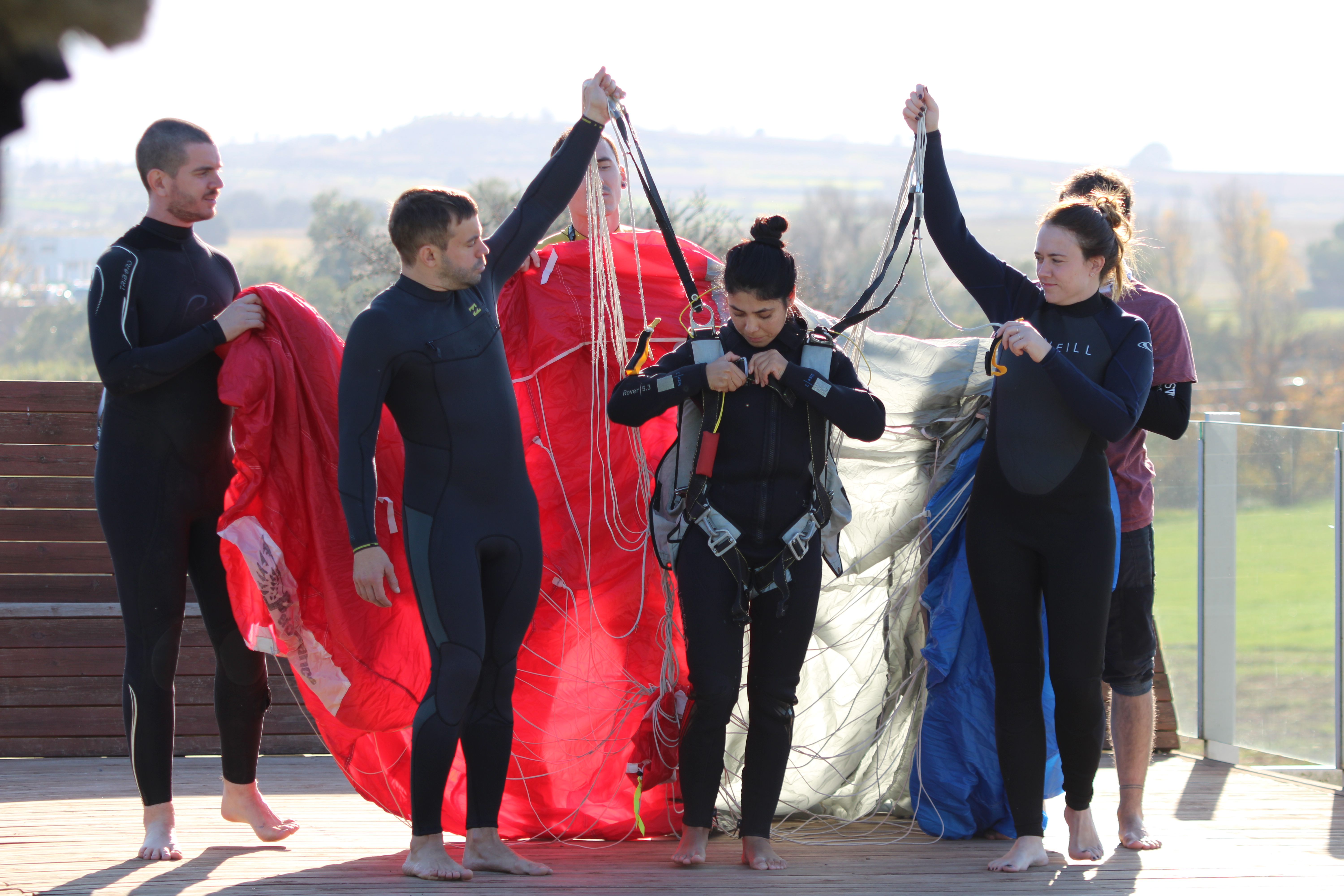
Landing Emergencies
Water Landings
Procedures for unintentional water landings focus on actions to take before entering the water (if time allows), during landing, and after being in the water:
- Before entering the water:
If time permits, release the chest strap to make it easier to exit the harness once in the water. If applicable, open the helmet visor, activate the flotation device, and disconnect the RSL to reduce complications in case a cutaway is needed after water contact.
- During the water landing:
Perform a half-brake flare approximately 10 feet above the surface, keeping in mind that depth perception over water may be distorted. Be prepared to execute a PLF if the water is shallow.
Just before entry, take a deep breath to fill your lungs with air. Remain in the harness and connected to the canopy until fully submerged. Once in the water, release the main canopy and swim forward to exit the harness.
- After the water landing:
Without flotation gear, it’s essential to separate from the rig. The container may float if the reserve is packed inside. If using the rig as a flotation device, be cautious of suspension lines. A container with a packed reserve has been shown to float for 45 minutes or more.
If the collapsed canopy covers you, dive down and swim out. Follow a seam to the edge of the canopy to free yourself.
If under a main canopy in moving or shallow water, pull a brake line or cut away to avoid entanglement or being dragged by the wind or current.
Keep lungs filled with air as much as possible. Swim against the wind or current and avoid entanglement with suspension lines. If wearing a full-face helmet and experiencing breathing issues, remove it. Do not attempt to retrieve gear.
Using weights to increase fall rate or additional gear like wingsuits, cameras, or skysurf boards increases water landing risk, so plan accordingly.
More details on water landings can be found in SIM Chapter 2-1 (USPA Basic Safety Requirements for water jumps) and Chapter 5-4 (Recommendations for Water Landings—intentional and unintentional).
Power Lines
Power lines are a serious hazard for all pilots. It’s essential to know their location near the DZ.
To avoid them, identify their location as early as possible and steer clear well in advance. If a low turn is necessary to avoid a line, execute a flat, half-braked turn. Finish the turn with a flare and prepare for a hard landing with a PLF.
If contact is unavoidable, fly the canopy in deep brakes and prepare for a PLF, keeping feet and knees together and head turned to one side to protect the chin. Land parallel to the lines to avoid contact with more than one wire at a time.
If suspended on the wires, do not allow anyone to touch you, as nylon suspension lines can conduct high-voltage electricity. Wait for DZ staff to contact the power company. Only their personnel have the training and authority to shut off power and ensure it stays off.
If your feet are on the ground, disconnect the RSL and cut away to release the main.
Trees
Avoiding trees begins with good terrain recognition and careful landing pattern planning based on current conditions. Tree landing risks remain until you’re safely rescued and on the ground. A sharp low turn can be just as dangerous as the impact itself. If a turn is needed, it must be flat and followed by a full flare, preparing for a PLF upon ground contact.
If tree impact is inevitable, fly in half brakes until contact, and prepare for a PLF—many times, you may pass through branches and hit the ground. Before impact, protect yourself by keeping your feet and knees together (not crossed). Cover your face with your hands and press your elbows to your chest—without letting go of the toggles, which is why you maintain half brakes.
Different tree types may require different responses, so consult your local S&TA for guidance specific to your DZ. If the trees are tall, aim for the center and grab the trunk or main branches to avoid falling to the ground.
If suspended, wait for DZ staff. Do not attempt to descend without trained personnel or rescue equipment.
Buildings and Other Objects
To avoid buildings and obstacles, plan your landing pattern early and steer away from them. Always focus on open, clear areas and direct your flight path accordingly. When turning low to avoid obstacles, use flat turns to keep the canopy level.
If a building or object landing is unavoidable, prepare for a PLF and flare at about 10 feet to reduce horizontal speed. After landing on a structure in windy conditions, immediately disconnect the RSL and cut away the main to avoid being dragged. If under reserve, gather and secure the canopy before removing the harness.
If approaching the side of a building, make a flat turn to avoid a frontal impact. If impact is unavoidable, prepare for a PLF against the structure. If possible, use the bounce to redirect your canopy and prepare for a second PLF on the ground.
Although these landing scenarios are rare, they present a significant risk to your physical safety if they occur. Therefore, USPA recommends monthly practice of emergency canopy procedures in a suspended harness, as well as hop and pop or high pull jumps where you can practice flat turns and flares initiated from flat turns.
These drills develop the skills needed to minimize injury risk during landings.
References
- USPA Skydiver’s Information Manual, 2025 Edition. Chapter 4-1, Section G (Landing Emergencies).
- USPA Skydiver’s Information Manual, 2025 Edition. Chapter 5-4 (Water Landings).