- Canopy malfunctions & emergencies
Malfunctions or emergencies are an inherent reality of skydiving. Staying constantly informed about the most appropriate way to respond to these
situations allows for a lucid reaction, based on knowledge and prior preparation.
Most malfunctions or emergencies under canopy are due to three main
causes:
1. Inadequate or unstable body position during parachuted eployment
2. Equipment failure.
3. Incorrect or careless packing.
It is possible to classify canopy malfunctions in the following way::
1. Unsual situations:
These are common situations that we frequently face as skydivers and that can generally be resolved with a controllability check (two full flares and turns to both sides) as long as sufficient altitude is available.
If not resolved, they can become low-speed malfunctions. If they cannot be resolved, the emergency procedure must be executed before reaching decision altitude (2,500 feet for students).
Unusual situations include: slider up, outer cells not inflated, and line twists.
2. Low-speed malfunctions:
These are considered low-speed malfunctions when five or more cells remain pressurized. This type of malfunction can be resolved through a controllability check, always maintaining altitude awareness.
Even though the descent rate has decreased, one is falling faster than normal compared to a canopy in optimal conditions.
Low-speed malfunctions include: tension knots, line-over, and broken lines or cells. If they cannot be resolved, the emergency procedure must be executed before reaching decision altitude (2,500 feet for students).
3. High-speed malfunctions:
These are considered high-speed malfunctions when the parachute has less than five pressurized cells.
In some cases, corrections can be attempted (within 5 seconds or a maximum of two attempts), but one must act quickly, as the fall rate can be similar or close to terminal velocity in freefall. High-speed malfunctions include: horse-shoe, streamer, pilot chute in tow, bag lock, among others. If they cannot be resolved, the emergency procedure must be executed before reaching decision altitude (2,500 feet for students).
Let us be reminded that the emergency procedure consists of a specific series of actions, which, if not executed in the correct order, could result in far greater and more difficult complications to resolve. The steps of the emergency procedure are:
Emergency Procedures
1. Breathe, arch.
2. Look at cutaway handle, grab cutaway handle.
3. Look at reserve handle, grab reserve handle.
4. Peel cutaway handle, pull cutaway handle.
5. Peel reserve handle, pull reserve handle.
6. Arch.
Since there are multiple types of malfunctions and ways to try to resolve them, a flowchart that summarizes all previously classified malfunctions is included below
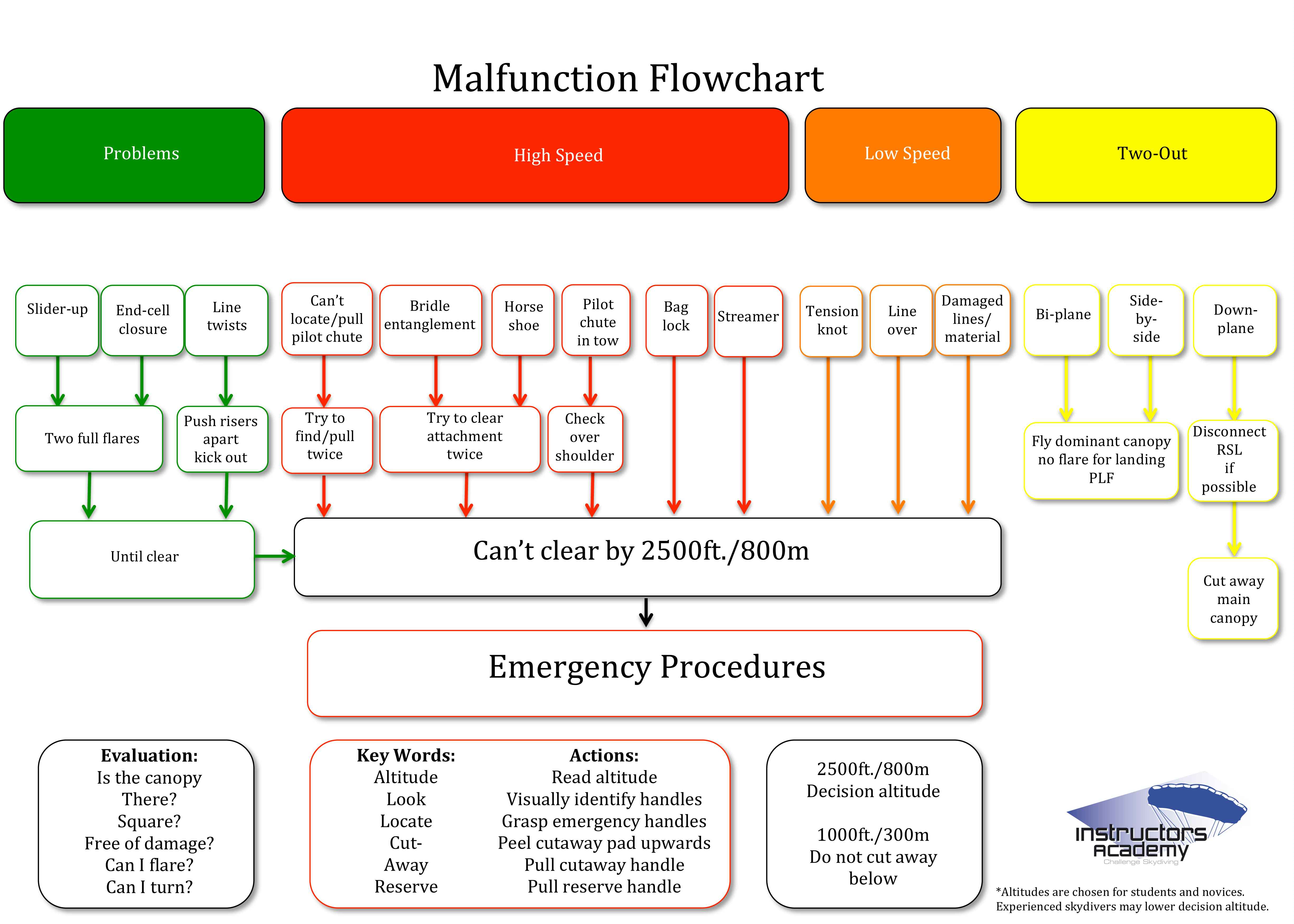
In the event of an emergency or malfunction below 1,000 feet, the main parachute must never be cut away, as this would result in freefall at a very
low altitude. In these cases, the reserve should be deployed directly.
In addition to the situations presented in the flowchart, emergencies due to canopy collisions may also occur. The best way to avoid a collision is prevention. One must always be aware of the location of other canopies.
Most canopy collisions occur shortly after deployment, when two skydivers deploy too close to each other, or below 1,000 feet while following the landing pattern.
Greater separation altitudes, better planning, and increased horizontal separation during the breakoff can help ensure clear airspace during deployment.Every time you deploy your canopy, keep your eyes forward, watching for other skydivers who may be opening directly in front of you.
Use the rear risers to maneuver as soon as inflation allows. Fly perpendicular to the aircraft’s flight line until you have identified the skydivers who jumped after you. Stay alert throughout the descent and check direction before initiating any turn. Canopy collisions and their preceding events can be complex, making it impossible to offer a single solution for every situation.
Although Section 4-1-F of the USPA Skydiver’s Information Manual (SIM) includes the recommended procedures for the most common canopy collision scenarios, we will leave this discussion for a further edition, as sufficient information has already been provided in this one
Conclusion:
Reviewing, analyzing, and regularly practicing emergency procedures prepare the skydiver to respond appropriately to problems that may arise during a jump.
It is recommended to dedicate one hop & pop or high-pull jump
- per month to practice under-canopy emergency procedure skills.
- Before each jump, procedures for both preventing and responding to emergency situations should be reviewed. Long intervals between jumps not only diminish skills but also increase anxiety.
- During each reserve repack, one can take the opportunity to practice emergency and reserve activation procedures on the ground. Simulating a main parachute malfunction, cutting away, and deploying the reserve is an exercise that provides practical knowledge about pull forces and pull direction on the equipment.
Proper preparation and responsible judgment significantly reduce the likelihood of facing an emergency. However, even with the greatest care,
these may occasionally occur. Being prepared to respond to various emergencies makes skydiving safer. One of the leading causes of fatal incidents in skydiving is the inability to effectively manage an emergency situation.
To conclude, we recommend watching the YouTube videos from the JoinTheTeem channel: “Freak-out Friday” and the malfunction series from the Australian Parachute Federation (APF), with the aim of developing solid judgment when analyzing emergency situations. The links to both channels are included in the bibliographic references.
Bibliographic references:
-
Australian Parachute Federation. “Malfunction videos.” Retrieved from https://www.youtube.com/watch?v=S_SKfKS1sKg&list=PLu1- y5SsauUkYW6F4S-WhrI4m6BhU9sc5 on May 18, 2025.
Teemsky. “Friday Freak-out series.” Retrieved from https:// www.youtube.com/@TEEMsky on May 18, 2025.
“ M a l f u n c t i o n fl owchart.” R e t r i e v e d f r o m https:// www.skydivemag.com/new/2018-12-18-malfunction-flowchart/ on May 18, 2025.
USPA. Skydiver’s Information Manual, 2025 edition. Chapter 4-1, Section F (Canopy Emergencies).